On the morning of November 4, Professor A. Murat Tekalp, a member of the Turkish Academy of Sciences and Academia Europaea and a professor in the Department of Electrical and Electronics Engineering at Koç University, delivered a lecture titled “Image Modeling: From Handcrafted Priors to Foundation Image Models” at the Huangdao Forum. He was invited by the Joint Laboratory for Cross-Media Big Data and the Shandong Chapter of the IEEE Computational Intelligence Society. The university’s Office of Science and Technology and College of Science jointly organized the event. Professor Wang Jian of the College of Science chaired the session.
Tekalp began with the fundamental questions of image modeling and traced how approaches to modeling visual perception evolved from handcrafted features to data-driven foundation image models. Looking back on nearly six decades of image and video processing, he highlighted three major stages. Early approaches relied on physical models for image restoration. Later methods incorporated handcrafted features such as edges and textures, as well as local descriptors such as SIFT. The deep learning era introduced end-to-end feature learning and foundation image models.
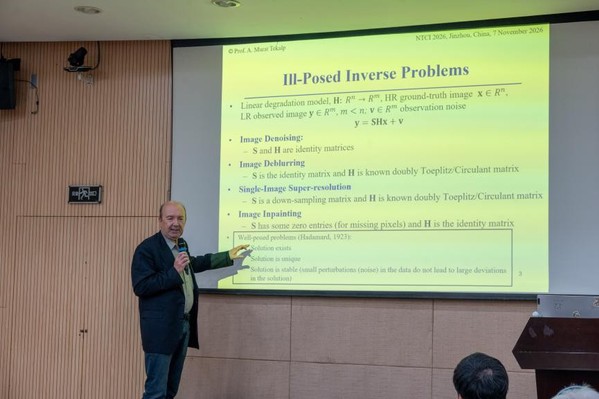
Professor A. Murat Tekalp delivers his lecture.
Drawing on his long involvement in developing the MPEG-4 and MPEG-7 international standards, Tekalp explained how traditional model-based coding and analysis methods contributed to streaming media, object segmentation, and video retrieval. He then examined the opportunities and challenges that foundation image models, including approaches based on diffusion models and vision transformers, bring to image generation, understanding, and reconstruction. He explained that foundation models learn priors implicitly from large datasets, changing the way prior knowledge is incorporated into image modeling. He also discussed how traditional explicit priors might be combined with modern foundation models in applications where data are scarce and high fidelity is required.
In closing, Tekalp drew on more than four decades in academia to encourage faculty and students to stay curious about fundamental questions. As technology evolves, he urged them to explore new methods while building a solid grounding in mathematics and signal processing.
During the discussion, faculty and students asked about the interpretability of foundation image models, temporal consistency in video generation, modeling with limited samples for industrial inspection, and how doctoral students can balance theoretical depth with engineering practice. Tekalp drew on his research and his experience developing international standards to answer each question with precision and practical examples.
[Editor:Shuaihao Deng, Yaoguang Zhang]