On the morning of November 4, Professor Vladan Devedžić of the University of Belgrade, a corresponding member of the Serbian Academy of Sciences and Arts, delivered a lecture titled “A Research Journey in the Age of Artificial Intelligence” at the Huangdao Forum. He was invited by the Joint Laboratory for Cross-Media Big Data and the Shandong Chapter of the IEEE Computational Intelligence Society. The university’s Office of Science and Technology and College of Science jointly organized the event. Chang Qin of the Joint Laboratory for Cross-Media Big Data at the College of Science chaired the session.
Devedžić outlined how artificial intelligence can support the entire research process and introduced some of the leading AI agents for research. He examined the ethical challenges that arise when researchers use these tools, proposed ways to address them, and set out principles for collaboration between researchers and AI. The lecture offered an overview of how AI is becoming integrated into research practice.
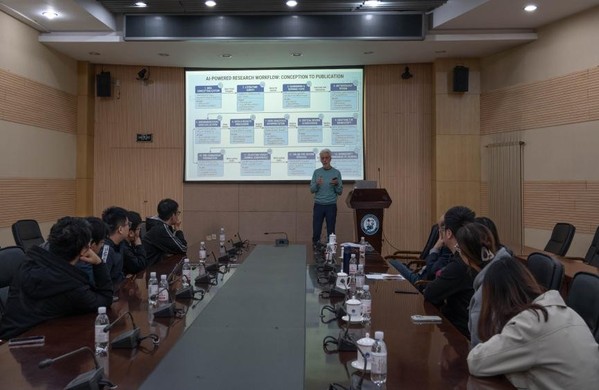
Professor Vladan Devedžić delivers his lecture.
The lecture followed the research process from the first idea through manuscript submission and publication. Devedžić explained how AI can assist in developing research topics, reviewing the literature, running experimental simulations, processing data, and drafting manuscripts. He traced the evolution of iterative research workflows from human-in-the-loop collaboration to direct interaction with large models and then to automated cycles involving specialized AI agents. He grouped research into four main components and emphasized that AI can offer suggestions, while researchers must make the key judgments and verify the results. He compared two types of AI agents for research, explained how they emerged and where each is useful, and weighed their benefits and risks in light of five ethical issues, including authorship, accountability, and model hallucinations. He also proposed practical ways to manage those risks.
“Artificial intelligence is a tool that supports research. Independent thinking and responsibility still rest with researchers,” Devedžić said as he concluded the lecture. He encouraged researchers to use AI to reduce repetitive work and explore new lines of inquiry while avoiding overreliance on the technology. He stressed the importance of upholding research integrity, manually reviewing all content, and accurately disclosing the use of AI tools in line with applicable rules. Setting clear boundaries for human–AI collaboration allows researchers to benefit from greater efficiency while maintaining the academic rigor needed to produce higher-quality work.
In the lively discussion that followed, faculty and students drew on their own research to ask how to use AI appropriately and what risks and precautions to consider. Drawing on years of firsthand research experience, Devedžić answered each question in detail.
[Editor:Shuaihao Deng, Yaoguang Zhang]