On the morning of November 5, Professor Bradley J. Nelson, a foreign member of the Chinese Academy of Sciences and a member of the Swiss Academy of Engineering Sciences, delivered a lecture titled “Microrobots for Clinical Applications” at the Huangdao Forum. He was invited by the Joint Laboratory for Cross-Media Big Data and the Shandong Chapter of the IEEE Computational Intelligence Society. The university’s Office of Science and Technology and College of Science jointly organized the event. Huang Fang, director of the International Office, and Wang Yudou, associate dean of the College of Science, attended. Professor Wang Jian of the College of Science chaired the session.
Nelson began by tracing the development of micro- and nanorobotics, explaining how magnetically actuated microrobots have advanced in materials, fabrication, and magnetic navigation and control. Over the past two decades, he noted, breakthroughs in functional materials, materials processing, and microfabrication, together with advances in modeling, sensing, and control, have brought clinically promising, biocompatible, and biodegradable microrobots closer to reality. These developments open new possibilities for minimally invasive diagnosis and targeted treatment in confined anatomical spaces and delicate tissues.
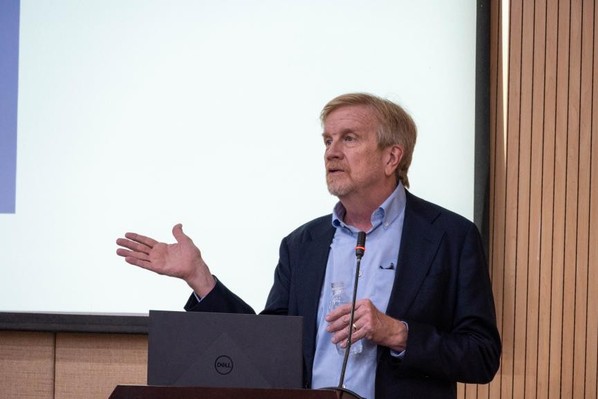
Professor Bradley J. Nelson delivers his lecture.
Drawing on his team’s years of work on magnetically controlled microrobot platforms, Nelson addressed the main barriers to bringing these devices into clinical practice. He explained that magnetic actuation can deliver power wirelessly, reach deep tissues, and generate controlled forces and torques without onboard batteries or physical tethers. He also examined the challenges of building magnetic navigation systems for use in the body, including generating magnetic fields over a workspace large enough to accommodate a patient, achieving precise and programmable control, ensuring compatibility with medical imaging, and meeting clinical safety requirements. He stressed that advanced magnetic navigation systems are essential for stable, safe operation in the body and for clinical translation. He outlined approaches to microrobot fabrication, magnetic field generation and control, and closed-loop navigation, and described potential applications of the platform, including telestroke medicine.
Nelson closed by drawing on his team’s long-term research to consider how the scientific vision of a “Fantastic Voyage” could become a medical reality. Rapid, remote intervention could give more patients timely access to care when every minute counts, he said. The prospect of micro- and nanorobots carrying out precise diagnostic and therapeutic tasks inside the human body is moving closer to reality.
In the lively discussion that followed, faculty and students drew on their own research to ask about the stability and safety of magnetically actuated microrobots in the body, the selection of biocompatible materials, the compatibility of magnetic navigation systems with medical imaging, and the practical barriers to implementing telestroke medicine. Nelson drew on years of firsthand research to answer each question in detail.
[Editor:Shuaihao Deng, Yaoguang Zhang]