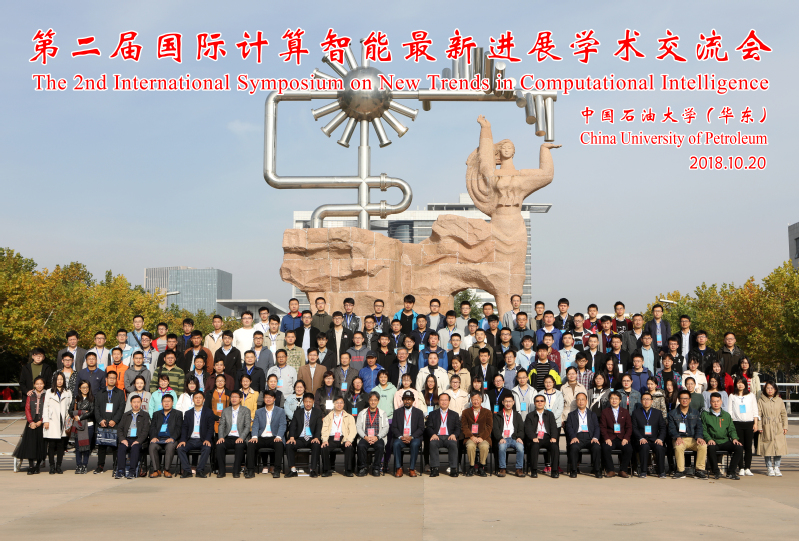
On October 20, the 2nd International Academic Symposium on Latest Advances in Computational Intelligence, hosted by China University of Petroleum (East China), was held. Yao Jun, Vice President of the university, and Nikhil R. Pal, Symposium Chair and Fellow of the Indian National Science Academy, attended the opening ceremony and delivered remarks.
Renowned experts in computational intelligence from India, Japan, the United States, Australia, Malaysia and Hong Kong, China, delivered invited speeches. All these experts are IEEE Fellows. The symposium drew extensive attention from researchers in the field, with over 300 participants including experts, scholars, researchers and postgraduate students from domestic and foreign universities and research institutes, as well as representatives from relevant enterprises.
Participating experts held discussions centered on Computational Intelligence (CI), Artificial Intelligence (AI) and Their Applied Technologies. They delivered keynote reports covering a wide range of topics: applications of advanced computational intelligence technologies in Condition-Based Maintenance (CBM), Brain-Computer Interface (BCI) and comprehensive agricultural sectors; performance metrics of Evolutionary Multi-Objective (EMO) optimization algorithms, biologically and socially feasible approaches (cooperative neurodynamic optimization techniques), and opportunities and challenges of reinforcement learning, presenting the latest research progress and achievements. The reports triggered active discussions and exchanges among the attendees.
The symposium provided a platform for relevant experts, scholars, researchers, engineers and students to present and learn about the latest research findings. It also offered a valuable opportunity for participants to exchange ideas and seek global cooperation partners, promoting the sharing of new theories, methods, technologies, achievements, perspectives and insights in the field of computational intelligence, and playing a positive role in advancing research in related domains.