How to apply supercomputing technology to smartphones, how to control robots efficiently, reliably and safely, and how to make artificial intelligence technology greener and low-carbon... These issues were thoroughly discussed at the 2022 International Artificial Intelligence Summit (Qingdao) & the Belt and Road Frontier Academic Conference on Computational Intelligence, held from December 15 to 17. Twenty-four experts and scholars in the field of computational intelligence from 17 countries including China, Germany, the UK, Canada, France, India, Poland and Turkey (among whom 21 are academicians and 15 are from countries along the Belt and Road) were invited to deliver keynote speeches, jointly exploring the latest progress and future trends in international AI-related fields. The conference was presided over by Pang Shanchen, Executive Dean of the Qingdao School of Software and Dean of the School of Computer Science and Technology.
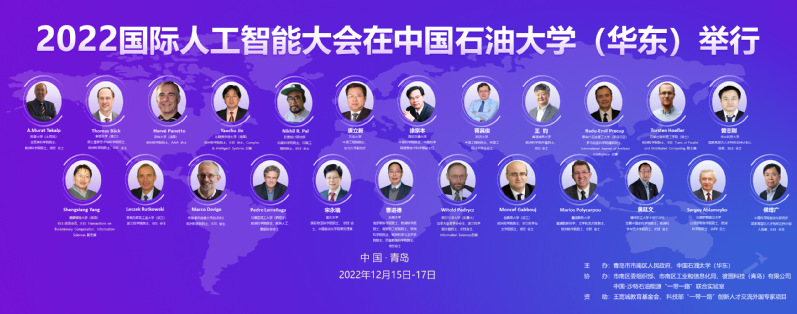
2022 International Artificial Intelligence Summit held at China University of Petroleum (East China). Photo by Wang Dayong.
The conference was held in a hybrid format of online and offline participation. It was co-hosted by China University of Petroleum (East China) and the People's Government of Shinan District, Qingdao; organized by the Qingdao School of Software, the School of Computer Science and Technology and the School of Science of China University of Petroleum (East China); and co-organized by the Organization Department of Shinan District Committee of Qingdao, the Bureau of Industry and Information Technology of Shinan District, and Bitu Technology (Qingdao) Co., Ltd.
Professor Tang Lixin, academician of the Chinese Academy of Engineering; Professor Nikhil R. Pal, academician of the Indian National Academy of Engineering, the Indian National Science Academy and The World Academy of Sciences; Professor A. Murat Tekalp, academician of the Turkish Academy of Sciences and Academia Europaea; Professor Leszek Rutkowski, academician of the Polish Academy of Sciences and Academia Europaea; Professor Dai Caili, Vice President of China University of Petroleum (East China); Luo Qun, Deputy Director of the Organization Department of Shinan District Committee of Qingdao; and Liu Pan, CEO of Bitu Technology (Qingdao) Co., Ltd., attended the opening ceremony and delivered speeches.
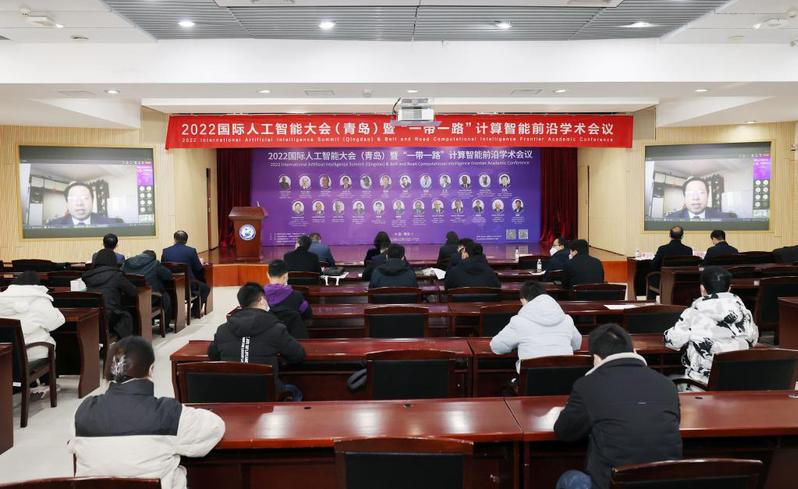
The summit focused on the latest advances of artificial intelligence in sectors including manufacturing, transportation, healthcare, smart grids, smartphones, robotics and computer vision. It also analyzed challenges brought by AI development, such as information security, ethics, legality and fairness, and discussed future development trends and response strategies for artificial intelligence.
This summit has demonstrated new breakthroughs in the theory and application of artificial intelligence, such as breaking the statistical assumptions of machine learning and realizing assisted healthcare through AI-robot control interaction, said Professor Wang Jian, co-chair of the summit and director of the Cross-Media Big Data Laboratory at the School of Science of China University of Petroleum (East China). Meanwhile, we have seen a growing number of researchers paying increasing attention to and addressing issues like privacy, security and energy consumption brought by AI development. We believe that high efficiency, security and green development will be the new trends of artificial intelligence in the future.
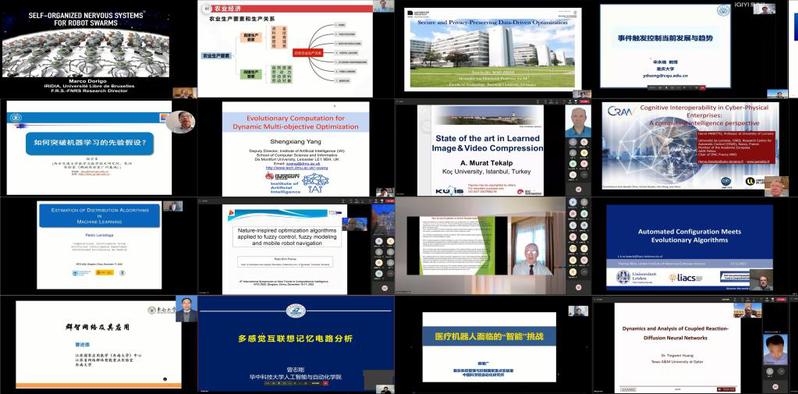
Experts and scholars delivering reports online.
Professor Witold Pedrycz, Fellow of the Royal Society of Canada and foreign academician of the Polish Academy of Sciences, pointed out that despite the numerous achievements of AI and machine learning in recent years that have influenced many areas of human development, traditional AI technologies usually demand massive computing power, and the resulting energy issue has become a major challenge for current AI development. He advocated designing and analyzing machine learning architectures from a holistic perspective, pursuing green and granular machine learning through federated learning, knowledge transfer and knowledge distillation, to mitigate the privacy and energy issues brought by AI advancement.
Professor Torsten Hoefler, academician of Academia Europaea from ETH Zürich, mentioned in his report that for a wide range of tasks from natural language processing, computer vision, image generation to mathematical reasoning and algorithm generation, AI learning models with billions of parameters are typically required. These models rely on large-scale parallel computing systems — supercomputers — for initial training, which is time-consuming and costly. He proposed multiple technologies covering data ingestion, parallelization and accelerator optimization to improve the efficiency of such training systems. For network models with hundreds of millions of parameters, new model compression and optimization techniques such as fine-grained sparsity and quantization reduce model size and significantly boost inference efficiency. He noted that with these technologies, complex training models originally only feasible on supercomputers can be implemented on smartphones.
Professor Nikhil R. Pal, academician of the Indian National Academy of Engineering, the Indian National Science Academy and The World Academy of Sciences, stated in his report that we are witnessing the remarkable success of artificial intelligence in gaming, natural language processing, healthcare, e-commerce, automotive, robotics and many other fields, and public expectations for AI are soaring. AI for everyone and AI everywhere have become a global trend. Any intelligent system should at least possess attributes of simplicity, transparency, fairness, interpretability, trustworthiness, sustainability and biological rationality. Yet it is extremely difficult for AI systems to realize all these attributes. Meanwhile, the development of AI has given rise to many ethical and social issues, including AI abuse. He predicted that AI research and development may enter a winter phase, and suggested moving beyond the mindset of the more complex, the better and drawing inspiration from the working mechanism of the human brain.
As the core driving force of the new round of technological revolution and industrial transformation, artificial intelligence is exerting an extremely far-reaching impact on global economic development, social progress and human lifestyles, said Vice President Professor Dai Caili at the opening ceremony. This summit focuses on the latest development trends of computational intelligence and deepens scientific and technological cooperation and exchanges. It will greatly elevate the scientific research and internationalization levels of AI-related fields at China University of Petroleum (East China) and in Qingdao, and actively promote the connotation construction and development of our university's national characteristic demonstration software school.
The summit drew more than 500 online and offline participants, and the live broadcast of the opening ceremony attracted over 6,000 viewers. The conference provided a sharing and exchange platform for cutting-edge research in the international artificial intelligence field, helping to deepen scientific and technological cooperation between China and countries along the Belt and Road, and advancing the academic and industrial development and innovation of AI and related fields in China and Belt and Road countries.
Media outlets including Xinhua News Agency, China Education News Network, Dazhong.com, Qilu Evening News and Qingdao Daily covered the conference.
Xinhua News Agency:
https://h.xinhuaxmt.com/vh512/share/11273534?d=1348d23&channel=weixin
China Education News Network:
shturl.cc/bqVEJ8kJm7qFJ14Z8VYwqPcqcvdk8GYCcjUz7JUohzWppM6gIKNrg5xm
China Shandong Network:
https://baijiahao.baidu.com/s?id=1752279235912821052&wfr=spider&for=pc
Dazhong.com:
http://sd.dzwww.com/sdnews/202212/t20221216_11183930.htm
China AI Network:
https://www.chinaai.com/zixun/471166.html
China Mining News:
https://mp.zgkyb.com/m/news/75587
Qilu Evening News:
https://3g.k.sohu.com/t/n656121810
Tencent News:
https://new.qq.com/rain/a/20221216A02BS200
Sina News:
https://k.sina.com.cn/article_1865978564_6f3892c401901537u.html?from=tech
Qingdao Daily:
https://www.guanhai.com.cn/p/228795.html