From October 17 to 19, the 7th International Conference on Latest Advances in Computational Intelligence (NTCI 2025) took place in Jinan. More than 200 representatives from universities, research institutions, and enterprises across China, Finland, the UK, the US, and other countries attended the conference to jointly discuss the latest progress and future trends of computational intelligence.
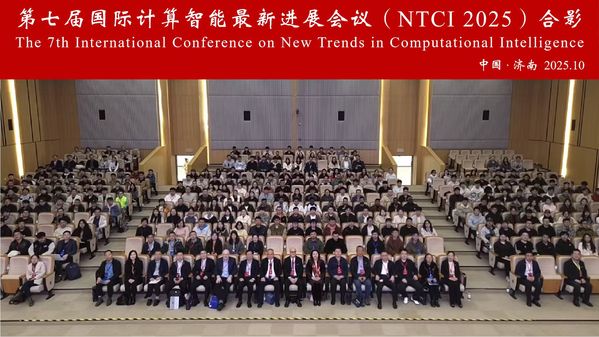
Conference Venue
This year’s conference was hosted by China University of Petroleum (East China), co-organized by University of Jinan, Shandong Women’s University, and Quancheng Provincial Laboratory, and supported by the Computational Intelligence Special Committee and the Optimization Scheduling & Decision-Making Special Committee of the Shandong Artificial Intelligence Society. It focused on in-depth discussions around cutting-edge directions of computational intelligence, including neural networks, machine learning, intelligent computing & pattern recognition, and intelligent information processing & analysis. The conference aimed to promote scientific research and development in computational intelligence-related fields, as well as facilitate interdisciplinary technology integration and international cooperation.
The conference invited 12 world-leading scholars in computational intelligence to deliver keynote speeches and 9 experts to give invited reports. It also set up 10 thematic parallel sessions and exhibited 36 academic posters, providing a platform for sharing and exchanging ideas on classical models, cutting-edge algorithms, and innovative applications of computational intelligence.
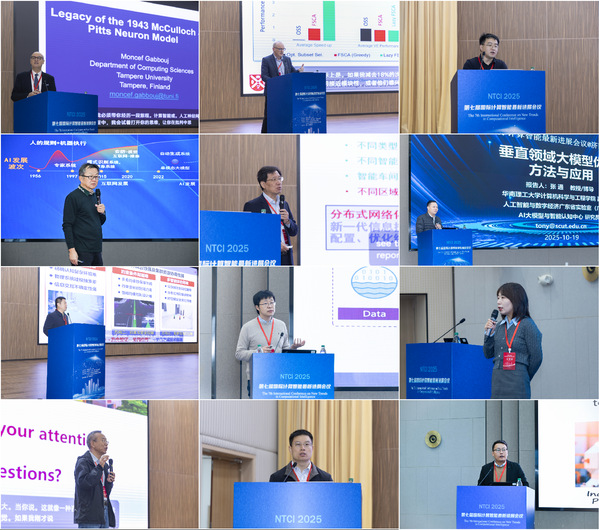
Conference Reports
Professor Mounir Ghribi from Tampere University, Finland (Fellow of the European Academy of Sciences and Fellow of the Academy of Finland), introduced a new type of Operational Neural Networks (ONNs). By introducing generative neurons, ONNs break through the learning capacity limitations of traditional convolutional networks, opening up a new path for green and efficient learning.Professor Junlong Chen from South China University of Technology (Fellow of the European Academy of Sciences and IEEE Fellow), discussed the development trends of artificial intelligence and its applications in AIGC. Taking human-computer interaction software robots such as AIGC/GPT series as examples, he explained the evolutionary characteristics and importance of human-computer interaction hybrid augmented intelligence.Professor Ling Wang from Tsinghua University (recipient of the National Outstanding Youth Science Fund), proposed a strategy self-generation mechanism, algorithm self-adaptation mechanism, and mode self-organization mechanism by combining machine learning and intelligent optimization. This provides theoretical and methodological support for scheduling optimization in intelligent manufacturing systems.Professor Xizhao Wang from Shenzhen University (IEEE Fellow), focused on the hallucination problem in large models and proposed a solution based on uncertainty modeling. This offers important insights for building interpretable and trustworthy generation mechanisms.Professor Sean McLaughlin from Queen’s University Belfast, UK (IET Fellow), focused on Principal Component Analysis (PCA) technology and introduced a more interpretable alternative—Forward Selection Component Analysis (FSCA). This technology significantly reduces computation time while maintaining performance.
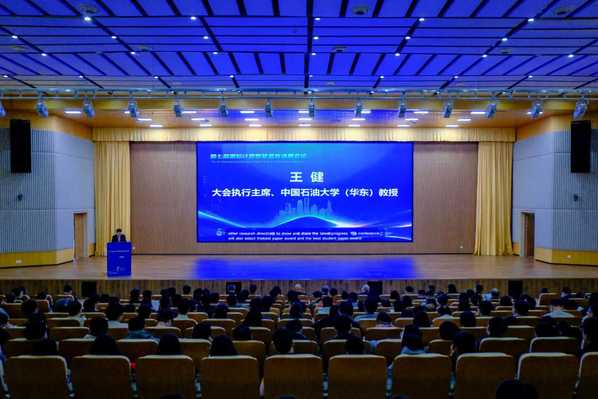
Conference Host
Professor Jian Wang from the School of Science of the host university (also Executive Chair of the conference), introduced the conference organization. Since its establishment in 2016, the International Conference on Latest Advances in Computational Intelligence (NTCI) has successfully held seven sessions, attracting over 5,000 researchers in total. It has invited 53 top experts, including academicians and IEEE Fellows from countries such as the US, UK, India, Australia, and Belarus, to deliver 90 reports. Since 2023, NTCI has been consistently indexed in EI, with over 300 papers included. It has received wide attention and coverage from major media outlets such as People’s Daily, People’s Network, Xinhuanet, and Science Network.Focusing on the future development of computational intelligence and exploring the frontiers of intelligent science, NTCI has become an influential academic platform in the international computational intelligence field. It provides a platform for global researchers to exchange ideas, share knowledge, and collaborate on innovation.
The conference was covered by Xinhuanet, Phoenix TV Online, the Creating the Sun News Network of China University of Petroleum, and the official website of University of Jinan.
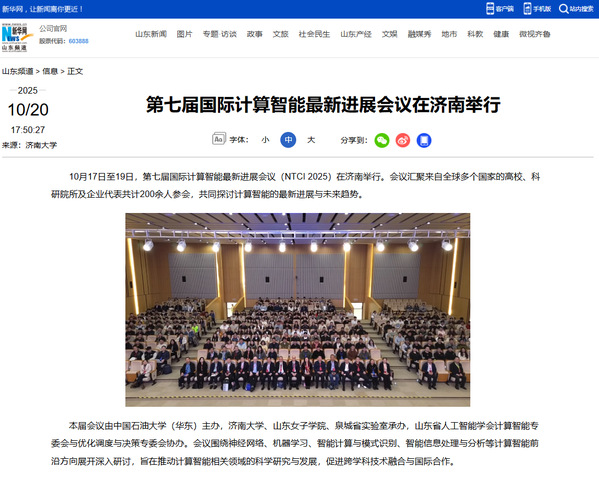
Xinhuanet
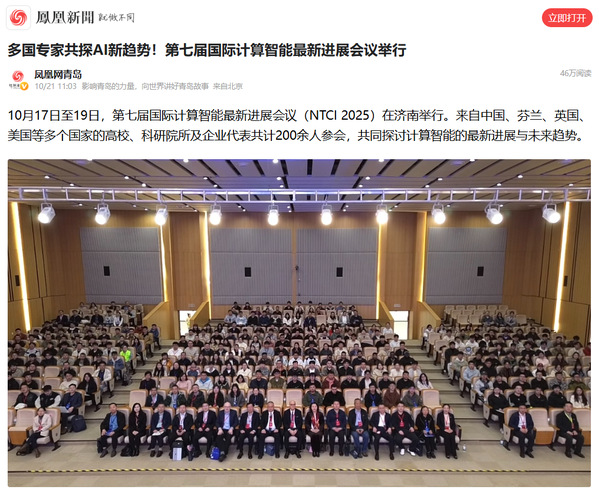
Phoenix TV Online
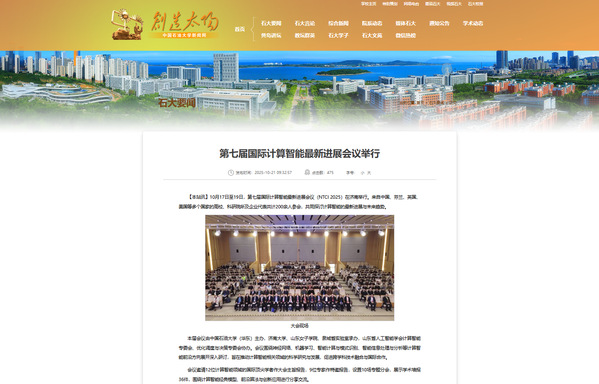
Creating the Sun News Network (China University of Petroleum)
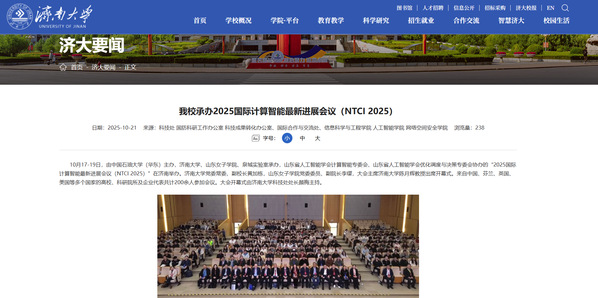
Official Website of University of Jinan
[Editor:Yaoguang Zhang]